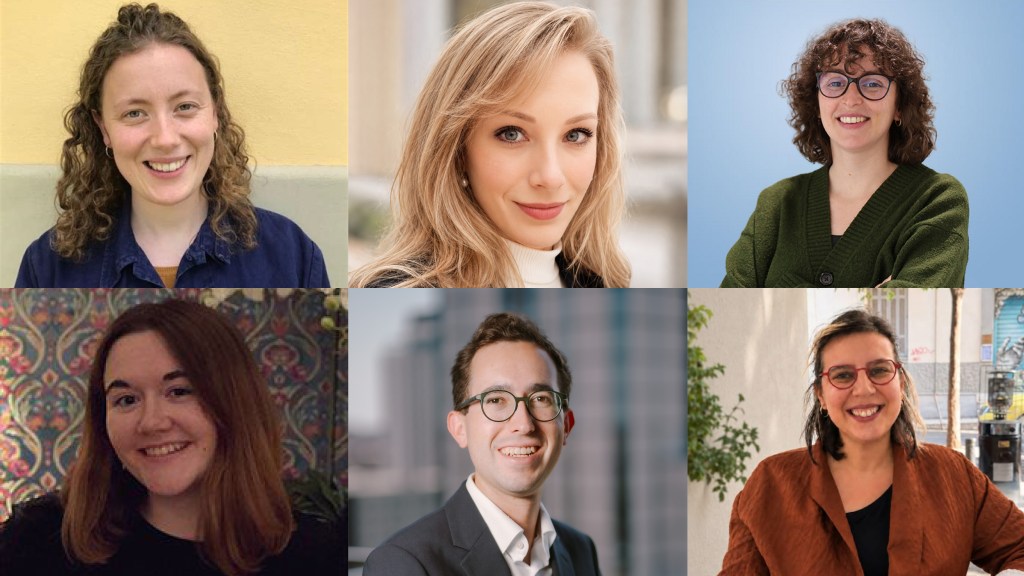
We are delighted to welcome our guest researcher to LUCK, who will be visiting us from 2–6 November. During the visit, they will take part in LUCK’s research environment, exchange ideas with colleagues, and contribute to ongoing scholarly discussions. We very much look forward to an inspiring week of conversations and new perspectives. This years guest researcher at LUCK are:
Nora Baker is a Research Fellow at the University of Birmingham, where she works on the Leverhulme Trust-funded project ‘French-language publications in England to 1685’. Her area of specialism focuses on religious communities in the seventeenth and eighteenth centuries, and at LUCK, she is particularly looking forward to collaborating with scholars in the ‘Early modern knowledge practices’ focus area. She is interested in studying French Protestant refugees in England as a distinct knowledge community, as evidenced by their production of pamphlets and polemical tracts. Her first book, Huguenot memory, 1689-1757: Narratives of imprisonment, enslavement and exile, was recently published by Liverpool University Press; this was based on her doctoral research at Jesus College, Oxford, funded by the UK’s Arts and Humanities Research Council. She has previously held postdoctoral fellowships at the University of Tokyo and the Université Libre de Bruxelles.
Evangelia (Lina) Chordaki is a postdoctoral researcher (University of Crete), Research Fellow (Research Center for the Humanities), and Adjunct Lecturer (Sociology, University of Athens). An interdisciplinary historian of science and knowledge, her work explores knowing as a way of making political worlds. Bringing feminist and queer theory into historical inquiry, she asks how ways of knowing become political practices—producing different possibilities for living, acting and imagining together. Her monograph, Making Sense of Knowledge: Feminist Epistemologies in the Greek Birth Control Movement (1974–1986) (Cambridge UP, 2025), and forthcoming edited volume, Queer(ing) Science, Queer(ing) Knowledge, develop this agenda. At LUCK, her project DEMOS explores postwar Europe, asking whether democracy has an epistemic history of its own and theorising democratic transformations as “epistemic transitions” that reorder how societies know, who claims expertise, what becomes credible, and how knowledge acquires political force.
Theodore (Teddy) Delwiche is currently a postdoc at the Center for American Studies (Heidelberg University) and (from Jan. 1) an Assistant Professor of Humanities in the Center for Humanities at the University of Texas at Austin. He is an intellectual and cultural historian of early modern North America. Much of his recent work has focused on the day-to-day realities and fine-grained practices of historical students, as well as the broader cultural questions that education invariably implicates. During his time in Lund, he plans to begin plotting his second book-length project on the history of Americans studying abroad.
Carolin Gluchowski is a postdoctoral researcher in Early Modern European History at the University of Hamburg. Her research explores manuscript cultures, devotional practices, gender, and the history of knowledge in late medieval and early modern Europe. At LUCK, she will work on her new book project, The Measure of Men and Women: Merit, Worth, and Social Advancement in Early Modern Europe, 1500–1800. The project asks how societies assessed individual worth before the emergence of modern meritocracy. It investigates how education, expertise, virtue, gender, confession, and social origin shaped access to offices, honours, and social advancement. By tracing concepts and practices of merit across learned, religious, and administrative contexts, it examines both the opportunities and the structural exclusions embedded in early modern systems of evaluation.
Caroline Montebello is a postdoctoral researcher in Global History of Europe and Switzerland at UniDistance Suisse. She received her PhD in History from the EHESS (Paris) and the University of Geneva in 2025. At LUCK, she will work on her first book project, based on her doctoral dissertation. The book examines the academic construction of anthropology and the transnational circulation of racial knowledge between 1840 and 1960. Focusing on Geneva and its connections with France, Romania, and Turkey, it places university teaching at the centre of the analysis, exploring how anthropology was defined, institutionalised, and transmitted. She is also involved in public history projects on colonial memory and gender in urban space.
Rebecca Orr is a Research Fellow in History at King’s College, University of Cambridge. Her work explores the history of imperial and postimperial migration, decolonisation, and critical family history in Britain and its empire. At Lund, she will be working on her forthcoming book titled The Ex-Empire Builders: How Settlers and Colonialists Shaped Postwar Britain. Specifically, she will be completing a book chapter that explodes how postcolonial migration influenced cultures of expertise in Britain during the 1960s and 1970s.